

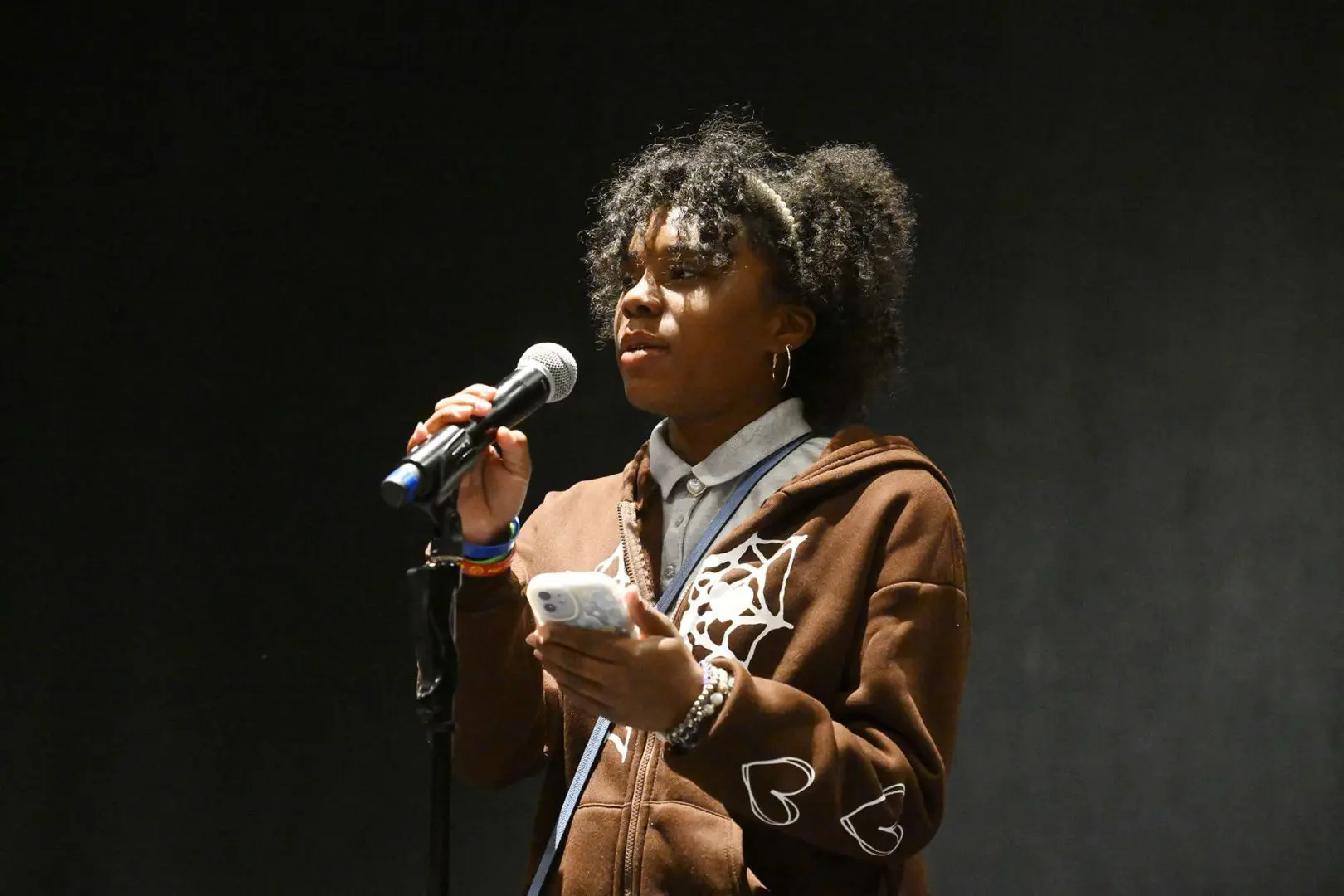
One of Higher Achievement’s five core values—voice—is key to scholars’ experience at center. Scholars are encouraged to use their voice at Higher Achievement as they develop into confident leaders.
The role of a scholar ambassador is one way in which scholars exercise their voice during programming. Scholar ambassadors are elected by their peers and act as liaisons between staff and all of the scholars at center. In conversations with their peers, ambassadors help to shape what incentives, activities, and field trips will take place throughout the year.
At the Greenbelt Higher Achievement Center, scholars help decide how much items at the scholar store should cost, what scholar jobs are offered, and what the dismissal call and response sounds like. They also answer a mood meter question each evening tied to Higher Achievement’s culture principles, such as “What does respect look like to you today? How do you want to see it shown at center?” Their answers build up the expectations of themselves and others while at Higher Achievement. “My job is to push what scholars want,” says Greenbelt’s Learning Director Mike Ruff. “We put the power in scholars’ hands and then we try to make it happen. Scholars know what we do, but we can adjust and create the experience they want. They are part of the community and it gives them a part of leadership in the space. Having scholars as the centerpiece for decision making adds to the experience.”
At Higher Achievement’s newest center, Highlandtown Achievement Center in Baltimore, Learning Director Milan Harris and Learning Coordinator Bentley Addison have seen firsthand the impact of scholar voice and choice in shaping center culture and creating a positive, empowering environment for scholars to grow. At Highlandtown, scholars help select the electives, activities, and field trips that are offered.
“There are some activities that are set, but we are open to what makes them the most engaged,” says Milan. “It gives scholars a sense of ownership and we give them the safety to express their thoughts, emotions, ideas, and inspirations.” Shared ownership at center fosters positive, trusting relationships between scholars, mentors, staff, and peers at Higher Achievement and helps scholars build confidence.
Highlandtown’s scholars come from a variety of cultural backgrounds that create a beautiful tapestry of perspectives at center. “We are learning a lot about our scholars through their decision making. They are shaping center through their cultural choices about food and their idea to practice bachata dance,” says Milan. “Scholars can bring their full selves to Higher Achievement, which is especially important when they’re not always able to do the same during the rest of the day. They all support each other here.”
“We are always asking, ‘What would make this empowering?’” says Bentley. This year, Bentley and Milan noticed 8th grade attendance dipping and so they asked the group what a motivational incentive would be to increase and maintain their attendance. “They were all super excited about hiking! I was not expecting that. We went to Patapsco Valley State Park and we had a great time. It really motivated scholars to continue to attend Higher Achievement.” say Bentley. “When we started in the fall, Highlandtown had two groups of scholars: the new ones, and the older students that knew that we actually meant what we said about taking their ideas seriously. It’s been cool to see scholars realize that it IS their center. It’s all about relationship building, trust building, and confidence building. We are challenging them to grow themselves and we allow them to share their full selves just as we share our own. Sitting and talking and listening to what is important to them and allowing their personalities to shine is so important.”
Equal to the power of voice is the power to listen. Staff and mentors at Higher Achievement actively listen to and guide scholars based on their expressed academic and social needs. Bentley recalls a time in which two 7th graders at center were feeling shy about their share out presentations and worried about negative attention and how their peers might react. “We acknowledged that they were feeling anxious, and that it was still an important activity for them to do. We asked, ‘How could you participate while feeling more secure?’ They chose to present science-fair style to smaller groups. Through that experience they learned that you can’t duck out of sharing, but you can do it in a way that’s more conducive to your preferences. I later heard from one of the scholars that it helped her come out of her shell,” says Bentley.
When a behavioral situation arises at center, Milan creates a space where scholars can feel safe to talk about what happened. “It’s not punitive, but we have to address it,” says Milan. “We talk to scholars about how to be respectful when expressing themselves and what tools they can use to manage their emotions. It helps them be more prepared to communicate outside of Higher Achievement.”
Practicing leadership and speaking up at center prepares scholars to advocate in their schools, communities, and beyond. “One of the lessons in our curriculum is about being a social advocate,” says Mike. “That lesson really impacted one of our scholars and she put up posters in her school about LGBTQ rights.” For one of Greenbelt’s scholar ambassadors, Aleah, being in a leadership position at her middle school afforded her the opportunity to visit the White House and meet President Joe Biden. “Higher Achievement is a place where we are training them to lead and take opportunities,” says Mike.
Mike and Milan are not only creating opportunities for scholars to speak up at center, but also by leading Higher Achievement’s newly formed Ambassador Council of Scholars & Alumni. The council is currently collecting data and conducting observations at center to help create a unified scholar experience across all of Higher Achievement’s fourteen achievement centers in Baltimore, Richmond, and the DC Metro region.
Higher Achievement scholars and alumni are speaking up to not only shape their Higher Achievement experience, but as advocates and leaders in their communities.
Post updated January 21, 2026
It is with deep gratitude that we share the impact of Higher Achievement’s 50th Anniversary Celebration and Campaign. Three years ago, we launched an ambitious strategic plan to invest in our core program, innovate to scale our impact, and strengthen our long-term sustainability. In tandem, we initiated our 50th Anniversary Campaign to meet these ambitious […]

On October 25, 2024, Higher Achievement hosted a special lunch conversation on the critical importance of the 8th to 9th grade transition. In a time where academic recovery, chronic absenteeism, and youth mental health struggles persist, this conversation offered potential solutions and practical advice. More than 50 participants joined in conversation with a panel of […]

Spirit of Baltimore. Growing up, I looked forward to graduations, birthday parties, and even school-sponsored events that would earn me a spot on the beloved vessel situated in Baltimore’s inner harbor waters. I remember vibrant, fun-filled times on the Spirit of Baltimore. Dancing. Laughing. Smiling. It was not unusual for a Baltimore City public school […]

Dear Higher Achievement Community, I could not be more excited to serve as the Executive Director of Higher Achievement- DC Metro. I began my Higher Achievement journey 13 years ago as an Achievement Coach at our Ward 7 Achievement Center at Kelly Miller Middle School. At the time, I had just received my Master’s degree […]

Last month Higher Achievement Baltimore celebrated our graduating 8th graders and the creative talents of all of our scholars during our Love Out Loud showcase. Scholars shared Latin and hip-hop dance performances, a theater showcase, original works of poetry, artwork created in partnership with MICA’s Community Arts program, and books by Highlandtown scholars’ project-based learning […]
DC’s Attorney General Brian Schwalb visited our Ward 8 Achievement Center and led an engaging conversation with scholars including discussing examples of when scholars have argued or persuaded others about something they’re passionate about, where scholars feel safe/unsafe in their communities and why, and brainstorming solutions to issues in the community. Scholars also had […]